Nike is now so embedded in football that it is easy to forget it was never supposed to be there. The company started by selling running shoes out of a car boot had no natural claim on the world's biggest sport. It claimed it anyway, and the story of how it did is one of the most deliberate brand-building exercises in sporting history.
A shoe that fell apart in the rain
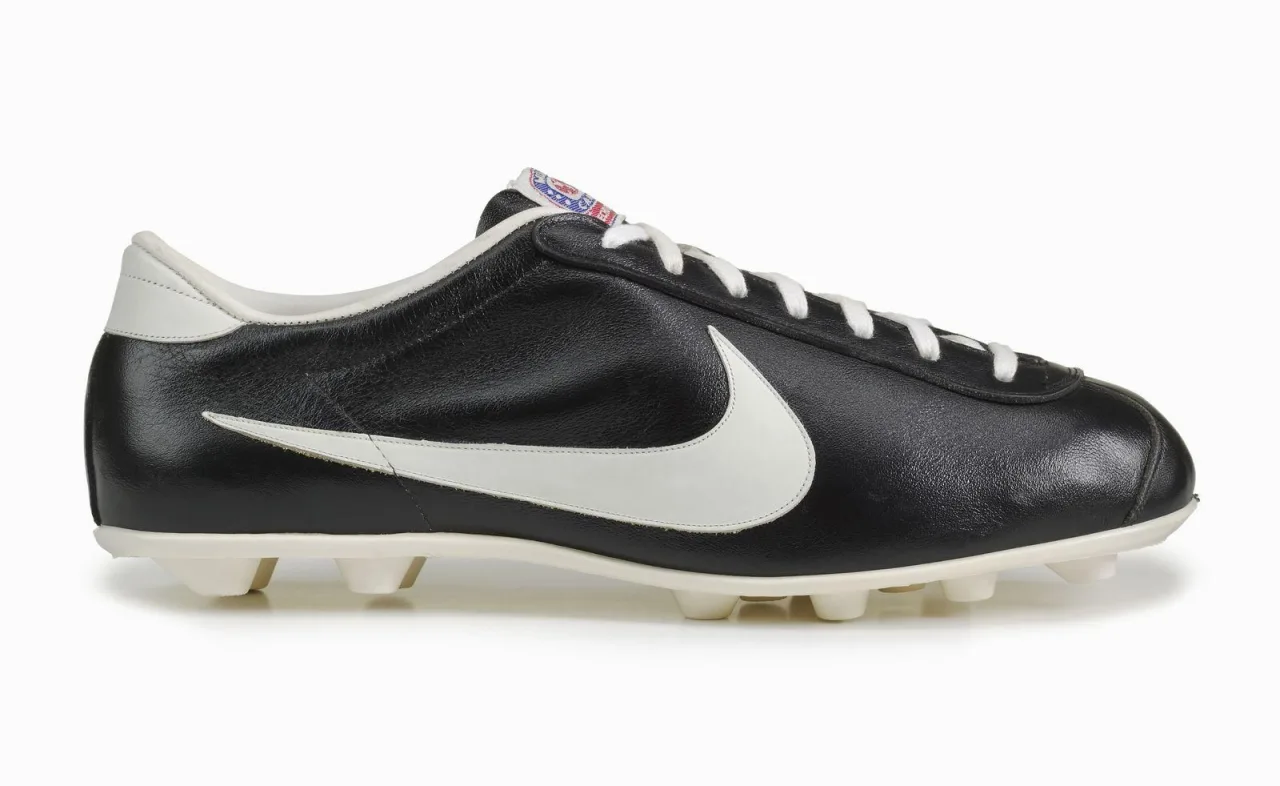
Nike's first attempt at football came in 1971. The Swoosh had only just been commissioned. Phil Knight's company was still finding its feet, and the product it put on footballers' feet reflected that.
The shoe was called simply "The Nike". It cost $16.95, bore the newly-designed Swoosh, and was designed to compete with the European boot manufacturers who already dominated the sport. The problem was straightforward: it was built for dry conditions and failed completely in wet ones. Football, played on grass in all weather, exposed the limitation immediately. Nike pulled the product and stepped back from serious investment in the sport.
For the better part of the next decade, European football was not a priority.
Portland, then the world
In 1978, Nike came back. The re-entry point was the Portland Timbers, a professional team in the American Soccer League. They became the first professional football club to sign with Nike, a fitting starting point given that Nike's entire story had begun in Portland. Within two years, Nike had signed ten regional associations and nearly forty individual players. The American foothold was established.
Europe was the real target. American football was a niche. If Nike was going to mean something in this sport, it had to mean something on the other side of the Atlantic.
1982: The year that changed everything
Nineteen eighty-two was the moment Nike's football story became real.
Two things happened in the same year that gave the Swoosh its first genuine European credibility.
The first was Sunderland AFC. Nike created its inaugural European team kit for a historic English club with a tradition going back to 1879. White and red vertical stripes, a V-collar, synthetic material with white sleeve edges finished by double red lines. Black shorts, red socks. The Swoosh sat on the left chest, at the heart, while Sunderland's naval crest was embroidered on the right sleeve. It was a modest, functional kit. But it was the first time a European football club had pulled on a Nike shirt, and that fact alone made it significant.
The second was Aston Villa. Villa won the European Champion Clubs' Cup in Rotterdam that May, beating Bayern Munich. Nike had boot sponsorship deals with several players in European football at this point, and the tournament gave those relationships visibility. Later that same year, Ian Rush, already one of the most lethal strikers in Britain, signed one of Nike's early individual boot contracts in Europe.
In the space of twelve months, Nike had its first European kit and its boot on the feet of a European champion's players. The platform was taking shape.
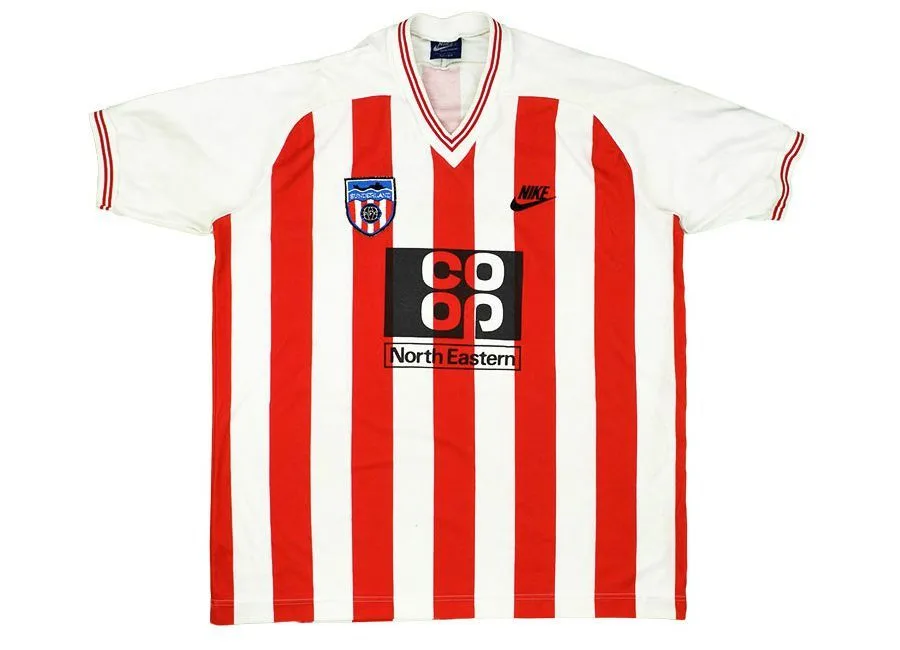
Sunderland AFC · 1982
Nike's first European kit
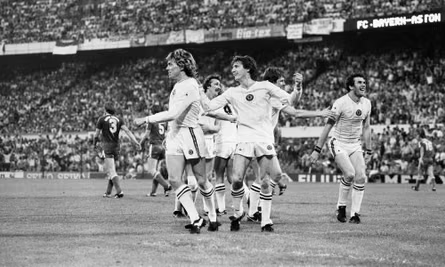
Aston Villa · 1982
European Champions, Nike boot deals on the squad
The Brazil deal that defined an era
For more than a decade, Nike built steadily. Boots, regional deals, individual athlete contracts. Then, in 1994, something happened that pointed at what Nike was about to become.
Eight of Brazil's twenty-two players wore Nike Tiempo Premier boots during their World Cup victory in the United States. Brazil were the most watchable team in the tournament, and those eight players were some of the most visible footballers on the planet. Nike noticed.
In 1996, Nike became the official kit sponsor of the Brazilian Football Confederation (the CBF). The deal was worth approximately 160 million dollars over ten years and was the largest sponsorship in football history at the time. Brazil were the world champions, the most globally recognised footballing nation, and now they wore the Swoosh. That one contract repositioned Nike in football in a way that a hundred smaller deals could not have achieved.
That same year, Nike opened a dedicated boot manufacturing facility in Montebelluna, Italy, the town historically considered the centre of European boot production. The message was deliberate: Nike was not an American outsider anymore. It was a serious manufacturer with serious European infrastructure.
The first shirt Nike actually produced for the Seleção. The CBF deal was signed in 1996 but this is where the Swoosh first appeared on the yellow shirt, the start of one of football's most iconic kit partnerships.
Ronaldo and the Mercurial
The Brazilian deal gave Nike visibility. What it needed next was a moment.
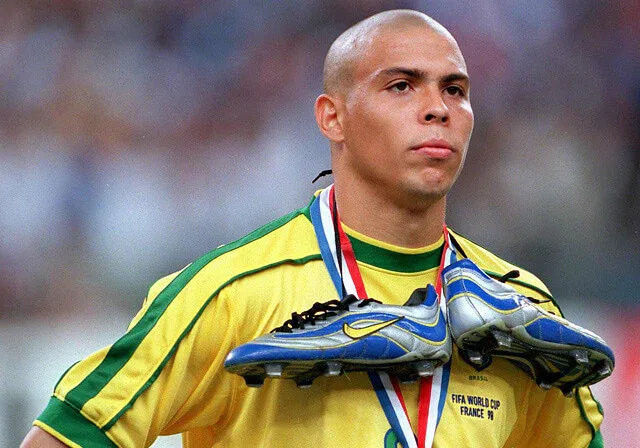
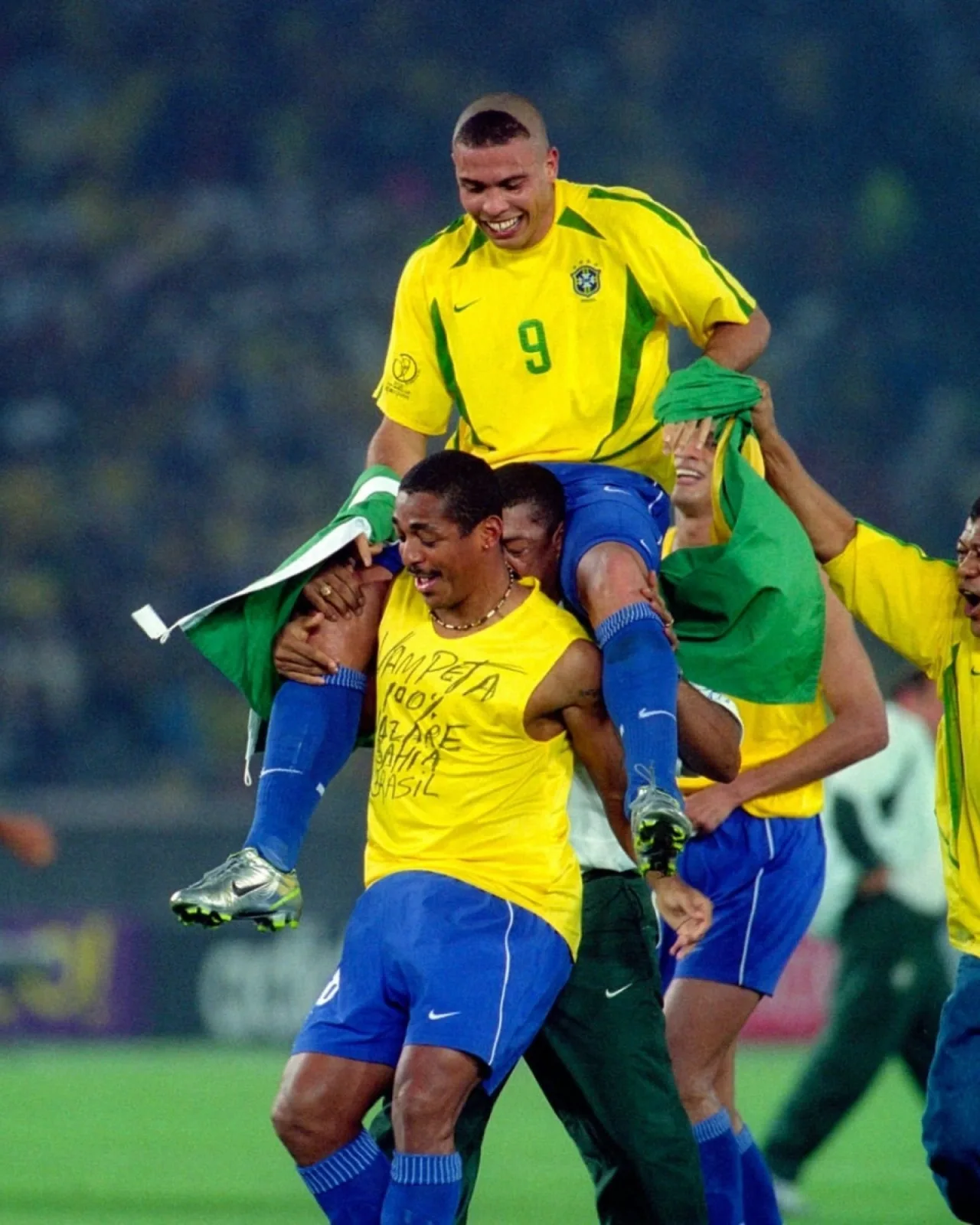
In 1998, Nike provided its own. The Mercurial boot debuted at the World Cup in France, on the feet of Ronaldo. He was twenty-one years old, the best footballer in the world, and the most wanted commercial property in sport. Nike had signed him, built him a boot, and sent him to the biggest tournament on earth.
The Mercurial was unlike anything else on a football pitch. Low-profile, lightweight, built for pure speed. Ronaldo's presence in it gave the boot a visibility that money alone could not have bought. For anyone watching that tournament, the two became inseparable in memory.
A year later, the United States women's team won the World Cup. Brandi Chastain's celebration, shirt removed and sinking to her knees, revealed a Nike prototype sports bra. It was not staged. Nike had not planned that specific image. But the Swoosh on Chastain's chest, in the most reproduced sports photograph of that year, represented something broader: Nike was now a presence in every corner of the game.
Manchester United and the European club strategy
If Brazil was Nike's global statement, the move for Manchester United was the European one.
From 2002, Nike became Manchester United's official kit supplier, replacing Umbro on one of the most commercially valuable shirt deals in club football. United were the dominant English club of the era and one of the three or four most recognised brands in world football. The contract aligned Nike with precisely the kind of institution it needed to own the European market.
The first shirt Nike produced for Manchester United. Replacing Umbro on one of the most commercially valuable deals in club football, this kit marks the start of a partnership that would run for over a decade.
Barcelona followed. Nike's relationship with the club produced some of the best-regarded kits of the 2000s, including the 2005-06 home shirt worn during Ronaldinho's Ballon d'Or season, the Champions League-winning campaign, the standing ovation at the Bernabéu. By 2009, Barcelona had completed the first Spanish treble in the club's history. The squad was built on Xavi, Iniesta, and a teenage Messi. They wore Nike.
Ronaldinho's Ballon d'Or season. The Champions League final in Paris. The standing ovation at the Bernabéu. This shirt carries all of it.
Joga Bonito and the digital turn
In 2006, Nike ran one of the more ambitious marketing campaigns football had seen.
The "Joga Bonito" campaign (play beautifully) was built in partnership with Google and leaned heavily into online video and user-generated content at a moment when that infrastructure was still finding its form. It was not primarily a television commercial. It was a platform for short films, player content, and community material. Whether Nike was ahead of the curve or simply well-resourced enough to experiment at scale, the result was a campaign that reached audiences traditional broadcast never would have accessed.
Ronaldinho, Ronaldo, Thierry Henry, Cristiano Ronaldo, Wayne Rooney. All of them participating, all of them wearing the Swoosh. The campaign reached audiences that television never would have accessed. Nike was not just selling boots. It was producing content.
Four years later, "Write the Future" took the same instinct to television. The ad, released ahead of the 2010 World Cup in South Africa, followed individual moments for Rooney, Drogba, Ribéry, and Ronaldo, each one branching into a vision of triumph or disaster. It became the fastest-spreading piece of content in Nike Football's history at that point.
The boot innovations that mattered
Alongside the marketing, Nike was also making serious product.
In 1997, the company developed a premium synthetic leather boot during a testing programme. Athletes refused to return the test models when the programme ended. That is as clear a signal of product quality as a brand can receive.
In 2013, the Hypervenom launched with direct input from Neymar Jr. and Wayne Rooney. The boot introduced NIKESKIN, a thin film bonded to the upper to create a barefoot-like touch, and targeted the creative forward who needed close control rather than pure pace. It was a different category from the Mercurial, and it required Nike to develop an entirely new athlete-driven brief.
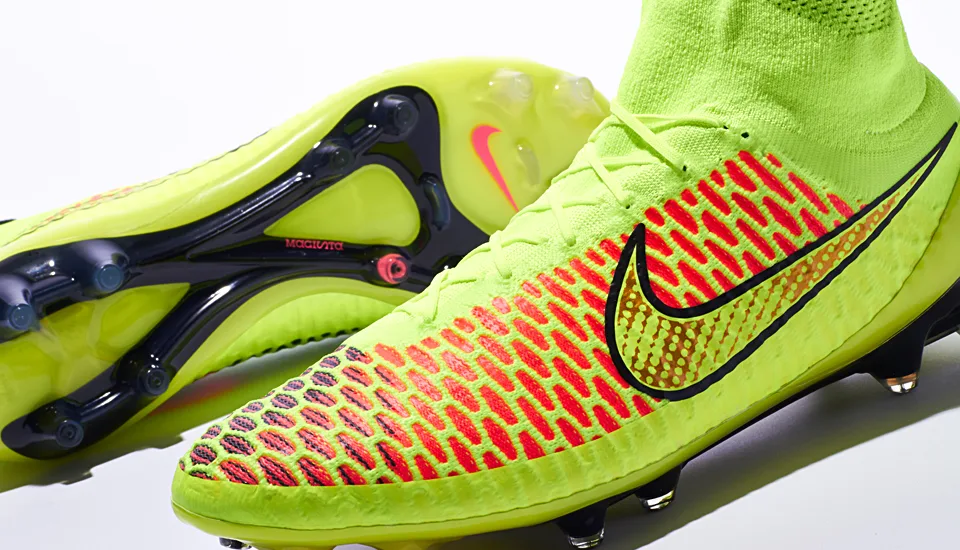
In 2014, the Magista and Mercurial Superfly arrived with Nike Flyknit uppers and mid-cut ankle collars. Flyknit, originally developed for running, changed what the upper of a football boot could be. Knitted rather than stitched, it wrapped the foot with a precision that welted leather never could. It was the most significant advance in boot construction in a generation.
What Nike became
The Sunderland kit of 1982 and the Magista of 2014 are separated by thirty-two years and by something much larger than time. One is a modest piece of club football history. The other is a performance object that redefined what football boots are made from.
The distance between them is the story of how Nike approached football: with patience, with deliberate choice of partners, and with an understanding that this sport would not be conquered in a season. The Mercurial was not a fluke. The Brazil deal was not an accident. Joga Bonito was not improvised. Every significant moment was a move made with clear intent.
The Swoosh is now on some of the most important shirts in the sport's history. That did not happen because Nike made good products. It happened because Nike understood, from the moment it came back in 1978, exactly what it was building toward.
Browse all Nike kits in the ShirtSociety catalogue.