Nobody gave them a chance. The bookmakers had Greece at 150-1 before the tournament started. In the previous decade the national team had won one competitive match at a major finals. Otto Rehhagel, a German coach appointed in 2001, had turned them into something organised and difficult to beat, but difficult to beat is not the same as capable of winning a tournament.
Over the course of twenty-three days in Portugal, Greece won four knockout matches by a single goal each and became champions of Europe. It remains the most improbable result in the history of the competition.
Porto, 12 June 2004
The opening match of Euro 2004 was the host nation against one of the tournament's outsiders. Portugal had Luís Figo and Rui Costa in midfield, a young Cristiano Ronaldo coming off his first season at Manchester United, and the Estádio do Dragão packed with a home crowd expecting a statement performance.
Georgios Karagounis scored in the seventh minute. Angelos Basinas converted a penalty in the 51st to make it 2-1 after Portugal had equalised. Greece had beaten the hosts in the opening game of a tournament they were not supposed to compete in.
Rehhagel's system was not built for attacking football. It was built on shape, defensive compactness and the ability to absorb pressure without conceding space in dangerous areas. Theodoros Zagorakis ran the midfield with Kostas Katsouranis and Stelios Giannakopoulos; Traianos Dellas and Michalis Kapsis were the centre-backs. Antonios Nikopolidis was in goal. None of them were players whose names appeared regularly in continental club football. That was the point of Rehhagel's team: it was a unit, not a collection of individuals, and the unit worked.
The knockout stages
Greece drew with Spain, beat Russia, and finished second in Group A. From there, the pattern became familiar: a goal from a set piece or a header, a defensive performance for the remaining time.
France in the quarter-finals. Zinedine Zidane, Thierry Henry, Patrick Vieira. France had won the World Cup in 1998 and Euro 2000. They had not lost a competitive match in nearly two years. Angelos Charisteas headed Greece in front from a corner in the 65th minute. Nikopolidis saved everything France sent at him. Greece won 1-0.
Czech Republic in the semi-final, also 1-0. Dellas headed in the silver goal in extra time, ending the match before penalties were needed.
Lisbon, 4 July 2004
The final was Greece against Portugal. Again. The same ground, the same opponent, the same crowd, the same scoreline from the opening match reversed in the minds of everyone in the stadium expecting a Portuguese victory.
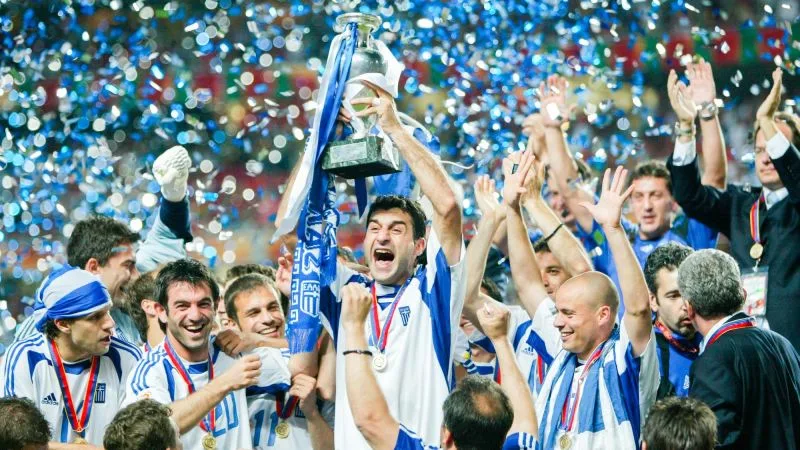
Charisteas headed the only goal of the match in the 57th minute. A corner from the right, a near-post run, a header that Vítor Baía could not stop. Portugal pushed for the equaliser. Greece gave them nothing. At full time, Rehhagel raised his arms on the touchline. His players, most of them unknown outside their own country, were European champions.
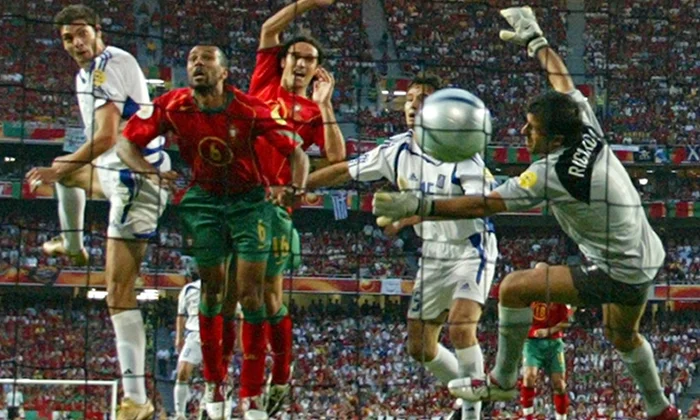
Zagorakis won the Player of the Tournament award. He had not scored a goal in the competition.
The shirt
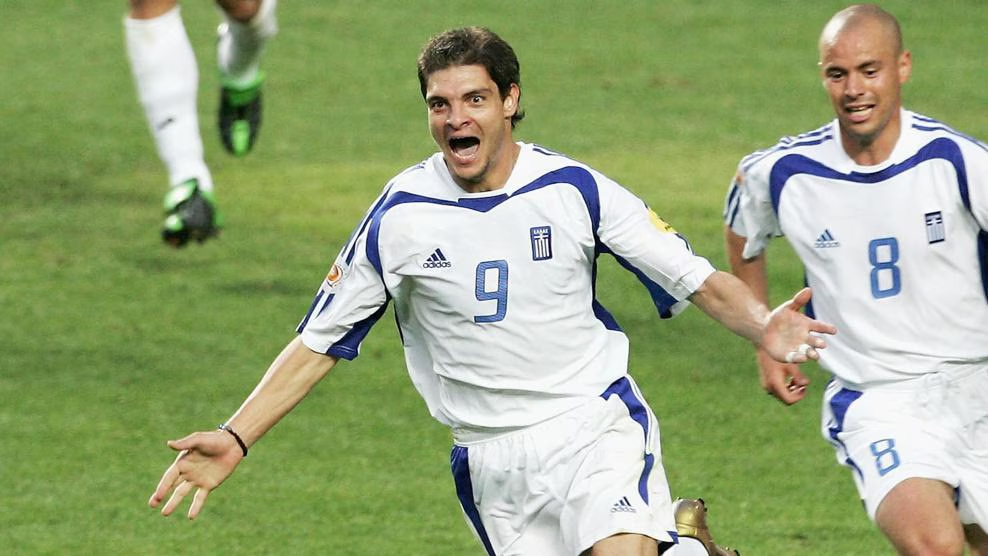
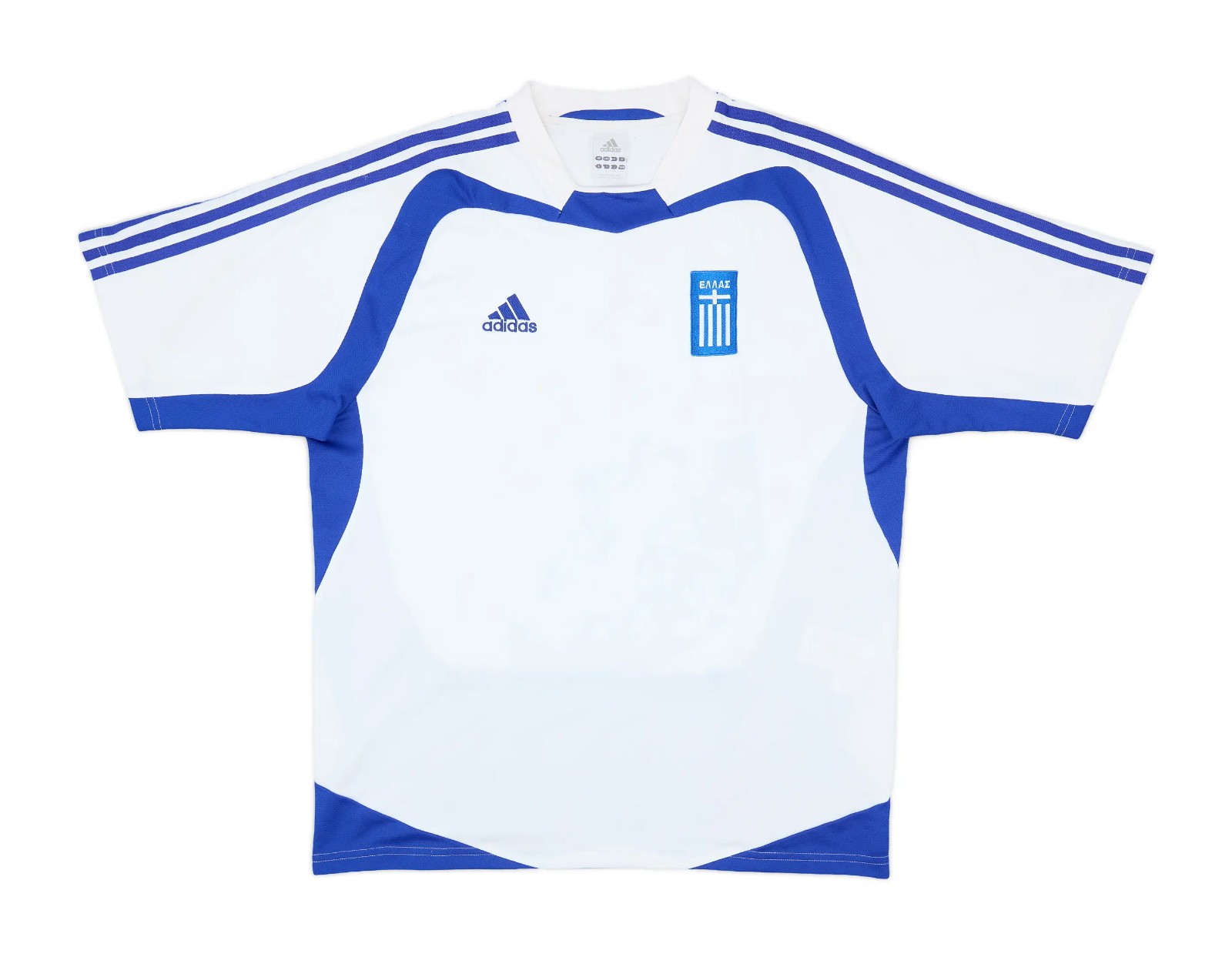
adidas had been supplying Greece for years. The 2004 home kit was white with blue trim, carrying the Hellenic Football Federation crest on the left chest and the adidas Three Stripes in blue on the shoulders. The collar was a simple crew neck. A thin blue stripe ran along the sleeve cuffs. It was clean and understated, designed to hold the national colours without spectacle.
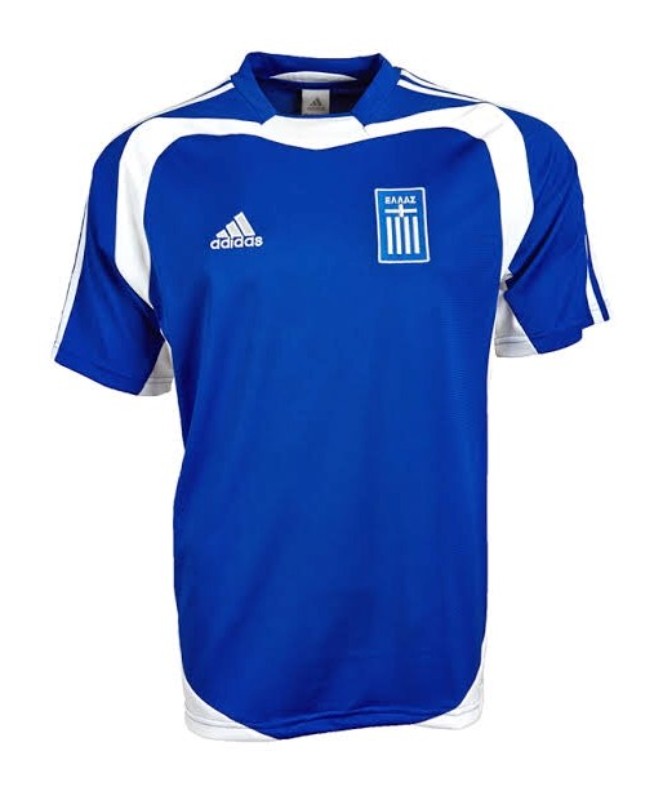
The away kit was the reverse: blue body with white trim. Greece wore it for some group stage matches, alternating between the two depending on the opposition's colours. Most of the memories attach to the white, which is what Charisteas wore in Lisbon when he headed in from the corner.
The shirt does very little to announce itself. There is no graphic pattern, no bold typographic element, no departure from the national colour scheme. It is white with blue trim, the same description that would apply to Greek football kits across several decades. What it carries is everything that happened inside it.
Collectors who find this shirt now are not buying the design. They are buying the corner in Lisbon. The header. The final whistle. The most implausible European Championship in the history of the competition, worn in a kit that had no reason to mean anything and now means everything.
adidas / Euro 2004
Greece 2004 home kit
In the ShirtSociety catalogue
adidas / Euro 2004
Greece 2004 away kit
In the ShirtSociety catalogue