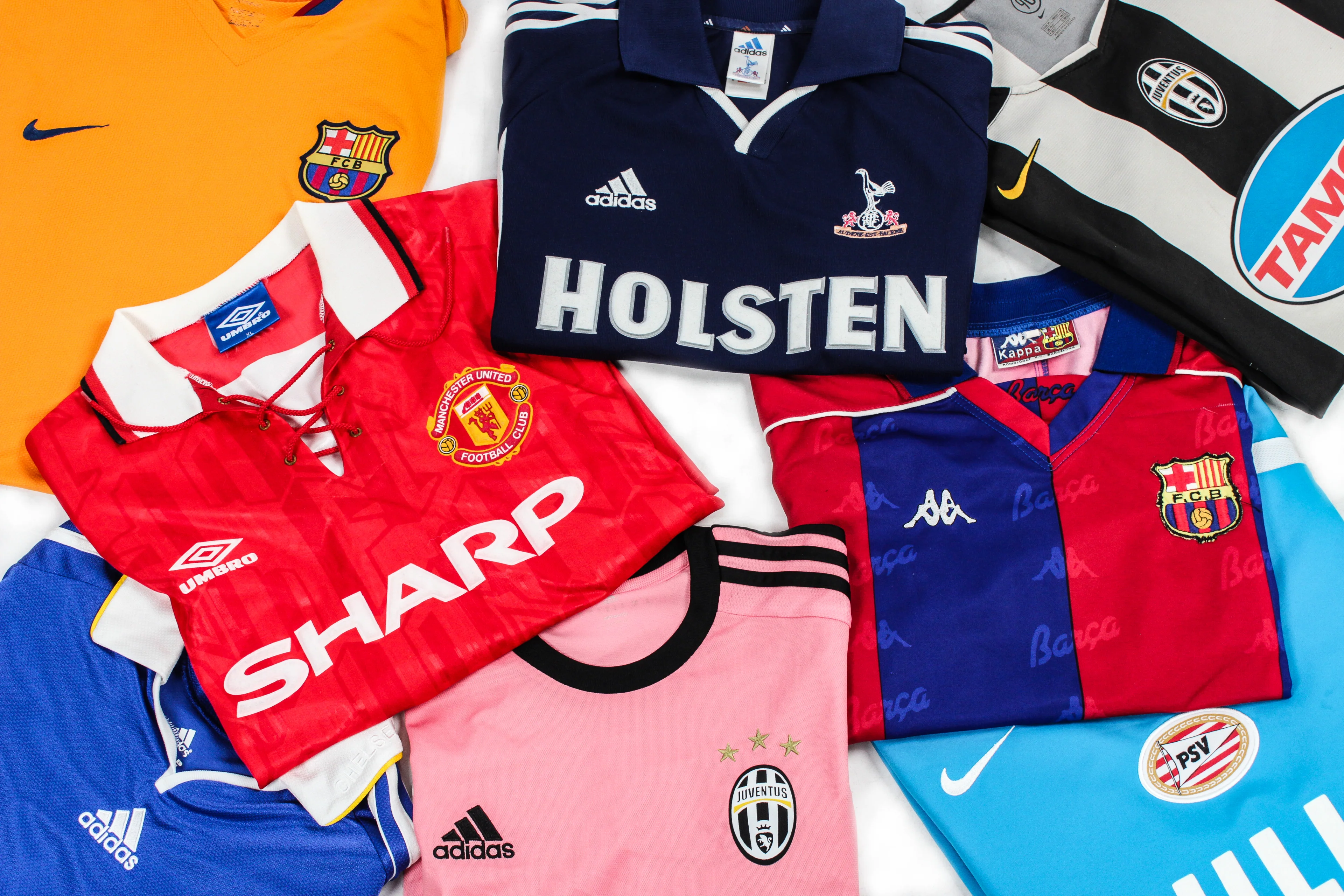
There is a moment every serious collector knows. You are in a charity shop, a car boot sale, or the back of a vintage clothing stall, and your fingers brush against something that stops you cold. You pull it out. You turn it over. You check the label: Umbro, Adidas, Kappa, Hummel. And you do a very quick calculation about whether you have the money in your wallet.
Football shirt collecting has the same grammar as record collecting. The thrill of the find. The language of editions and rarities. The quiet one-upmanship of the collector who always seems to know about something before you do. The holy grails that become the subject of years-long hunts.
The secondary market
The numbers tell their own story. A 1994 Colombia away shirt in good condition can fetch £200 on eBay. A player-issue Bayern Munich shirt from the early Adidas era, identifiable by the slightly heavier fabric and the individual size-adjusting side tabs, will go for significantly more. The platforms that track shirt values read like record price guides.
What drives this? Partly nostalgia, partly aesthetics, partly the pleasure of owning something that connects you to a specific moment in time. A shirt is not just a shirt. It is a Saturday afternoon in 1997, or a European final watched through your fingers.
The community
What separates shirt collecting from stamp collecting or coin collecting is the warmth of the people involved. Collectors share. They advise on authenticity, on cleaning, on storage. They celebrate each other's finds with genuine enthusiasm that can be hard to find in other collecting circles.
Instagram accounts dedicated to shirt collections have hundreds of thousands of followers. Discord servers run giveaways and trade nights. Online communities are built collectively, with collectors pooling knowledge about manufacturers, seasons, and variations. Nobody keeps anything to themselves.
The craft
There is also genuine connoisseurship involved. Learning to read the differences between a 1994 and 1995 printing of the same shirt. Understanding which labels indicate a player-issue garment rather than a replica. Knowing which manufacturers were producing technically excellent fabric in a given period and which were cutting corners.
This is not so different from learning the difference between a first pressing and a repress, or understanding why a particular run of a shoe model is worth three times the standard version. The knowledge accumulates slowly, and that is part of the point.
Start somewhere
The best time to start collecting is before the prices on something you love become prohibitive. Shirts from the mid-2000s, currently considered recent by many collectors, are already climbing. The 2010s will follow. They always do.
The advice is always the same: collect what you love. Buy the shirt of the club you grew up watching, or the player who made you fall in love with the game. Build the collection around meaning rather than investment, and the rest takes care of itself.
Your wardrobe is waiting.